If you've started shopping for a garage floor coating, you've run into two words over and over: epoxy and polyaspartic. Contractors argue about them, DIY kits blur them together, and it's hard to tell what actually matters for your garage.
Here's the short version from a crew that installs these systems around Buford every week: the best garage floors usually use both. Epoxy does the heavy lifting at the base, and a polyaspartic topcoat protects it from sunlight, hot tires and abrasion. Below we break down why — and when one alone makes sense. For the full picture of how coatings work, see our epoxy floor coatings hub.
What epoxy is good at
Epoxy is a two-part resin that soaks into properly ground concrete and cures into a hard, thick layer. Its biggest strengths are adhesion and build. A 100%-solids epoxy base coat grips the profiled slab, fills small pits and creates a stiff foundation for decorative flake or metallic pigments.
That's why nearly every professional flake system starts with an epoxy base coat. It has a longer working time than polyaspartic, which lets installers broadcast flake evenly or manipulate metallic pigments into the swirling, three-dimensional look people love.
- ▸Excellent bond to mechanically ground concrete
- ▸Thick, gap-filling build that hides minor surface flaws
- ▸Long working time for decorative flake and metallic effects
- ▸Strong chemical resistance to oil, antifreeze and road salt
Where epoxy falls short
Epoxy's weakness is sunlight. Most epoxies amber — turn yellowish — with UV exposure. In a Georgia garage where the door is open on summer afternoons, an epoxy-only floor can visibly yellow near the entrance within a couple of seasons.
Epoxy is also relatively brittle and scratches more easily than a polyaspartic surface, and it takes longer to cure. An epoxy-only system typically needs several days before you can park on it.
What polyaspartic brings to the floor
Polyaspartic is a type of aliphatic polyurea. It's UV-stable, so it won't yellow in the sun, and it's more flexible and abrasion-resistant than epoxy. It also cures fast — many systems allow foot traffic in hours and vehicle traffic in about a day.
Its speed is also its challenge: it has a short pot life and must be applied by experienced installers. That's one reason you don't find true polyaspartic in most big-box DIY kits.
Hot-tire pickup
Tires heated on a summer drive down I-985 can soften weak coatings and pull them off the floor. A quality polyaspartic topcoat is highly resistant to hot-tire pickup, which is one of the most common failures we see on cheap floors.
Humidity and Georgia weather
Northeast Georgia summers are humid. Professional installers schedule around dew point and slab temperature so the topcoat cures correctly. It's part of why we ask about your garage's sun exposure and ventilation when we quote.
Side-by-side comparison
Here's how the two resins compare on the factors homeowners ask about most:
- ▸UV stability — Epoxy: tends to amber. Polyaspartic: stays clear.
- ▸Adhesion to concrete — Epoxy: excellent. Polyaspartic: very good with proper prep.
- ▸Abrasion resistance — Epoxy: good. Polyaspartic: excellent.
- ▸Cure time — Epoxy: days. Polyaspartic: hours to a day.
- ▸Decorative working time — Epoxy: long. Polyaspartic: short.
- ▸Best role — Epoxy: base and color coat. Polyaspartic: protective topcoat.
Our recommendation for most Northeast Georgia garages
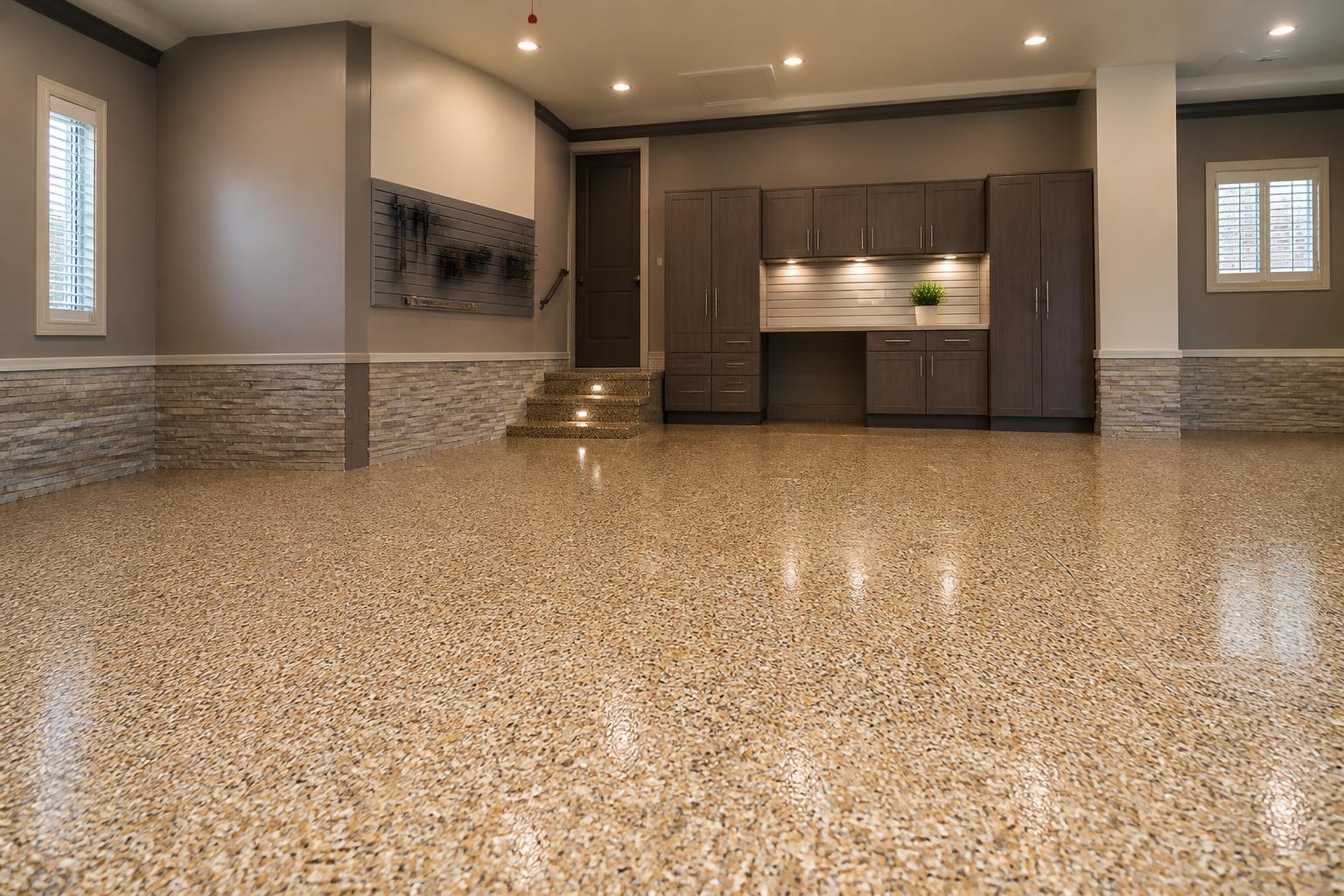
For a typical two-car garage in Buford, Suwanee, Flowery Branch or Gainesville, we recommend a hybrid system: mechanical grinding, an epoxy base coat, full-broadcast color flake, and a clear polyaspartic topcoat. You get epoxy's bond and build with polyaspartic's UV and abrasion protection.
Want the showroom look instead of flake? The same logic applies to metallic floors — see our guide to flake vs. metallic epoxy floors. Curious about budget? Our garage floor coating cost guide explains what drives price.
Prep matters more than the resin
The honest truth: the most expensive polyaspartic on the market will still peel if it's rolled over an unground, dirty slab. Diamond grinding opens the concrete's pores so any coating can bond. Cracks and pits are filled, and moisture is checked before a single coat goes down.
That prep step is standard on every garage epoxy coating we install — not an upgrade.
Frequently asked questions
Is polyaspartic better than epoxy?
+
Neither is universally better. Polyaspartic is better as a UV-stable, abrasion-resistant topcoat; epoxy is better as a thick, well-bonded base. Most high-performing garage floors use both.
Will an epoxy garage floor turn yellow?
+
Epoxy can amber with sunlight. A polyaspartic topcoat over the epoxy prevents most visible yellowing.
Can polyaspartic go straight onto concrete?
+
It can, but it must be installed quickly and correctly on ground concrete. We typically prefer an epoxy base for build and decorative work.